
If you’ve ever seen a mold remediation, water damage restoration, or major construction project, you may have noticed large machines running inside the work area. Those machines are likely air scrubbers.
An air scrubber is a portable air filtration machine that pulls air from a space, passes it through filters, and releases the filtered air back into the space or exhausts it elsewhere. During mold remediation, HEPA air scrubbers are commonly used to help capture mold spores, fragments, dust, and other particles that become airborne while contaminated materials are removed and the area is cleaned.
There’s one important distinction to understand from the start: An air scrubber filters the air. It does not remove mold growing on building materials or fix the moisture problem that allowed mold to grow.
That’s why air scrubbers are an important tool during professional mold remediation, but they aren’t mold remediation by themselves.

What Is an Air Scrubber?
An air scrubber is a machine designed to continuously filter the air within a space.
A fan pulls air into the machine and moves it through one or more filters before releasing the filtered air. Professional air scrubbers used during mold remediation are commonly equipped with high-efficiency particulate air, or HEPA, filters.
According to the U.S. Environmental Protection Agency (EPA), a HEPA filter should remove at least 99.97% of airborne particles measuring 0.3 microns, with particles both larger and smaller captured at even higher efficiencies.
That makes HEPA filtration useful during projects that can generate or disturb large amounts of airborne particulate, including mold remediation, water damage restoration, demolition, and construction.
How Does an Air Scrubber Work?
Think of an air scrubber as creating a continuous filtration loop.
Air enters the machine, passes through its filters, and is then discharged. As the machine continues running, more of the air within the work area passes through the filtration system.
Many professional air scrubbers use multiple stages of filtration. A pre-filter may capture larger debris and help protect the final filter, while the HEPA filter is responsible for capturing much smaller airborne particles.
During mold remediation, those particles can include:
Mold spores and fragments
Dust
Construction and demolition debris
Fine particulate matter
Other airborne particles that reach the filtration system
This becomes especially important when remediation work begins.
Mold contamination isn’t limited to what you can see growing on a surface. Mold produces microscopic spores, and contaminated materials can also contribute fragments and other particles to the surrounding environment.
Removing drywall, pulling insulation, HEPA vacuuming, cleaning structural materials, and performing other remediation activities can disturb particles that were previously settled or trapped within building materials.
An air scrubber helps capture some of those particles as they become airborne.
Why Are Air Scrubbers Used During Mold Remediation?
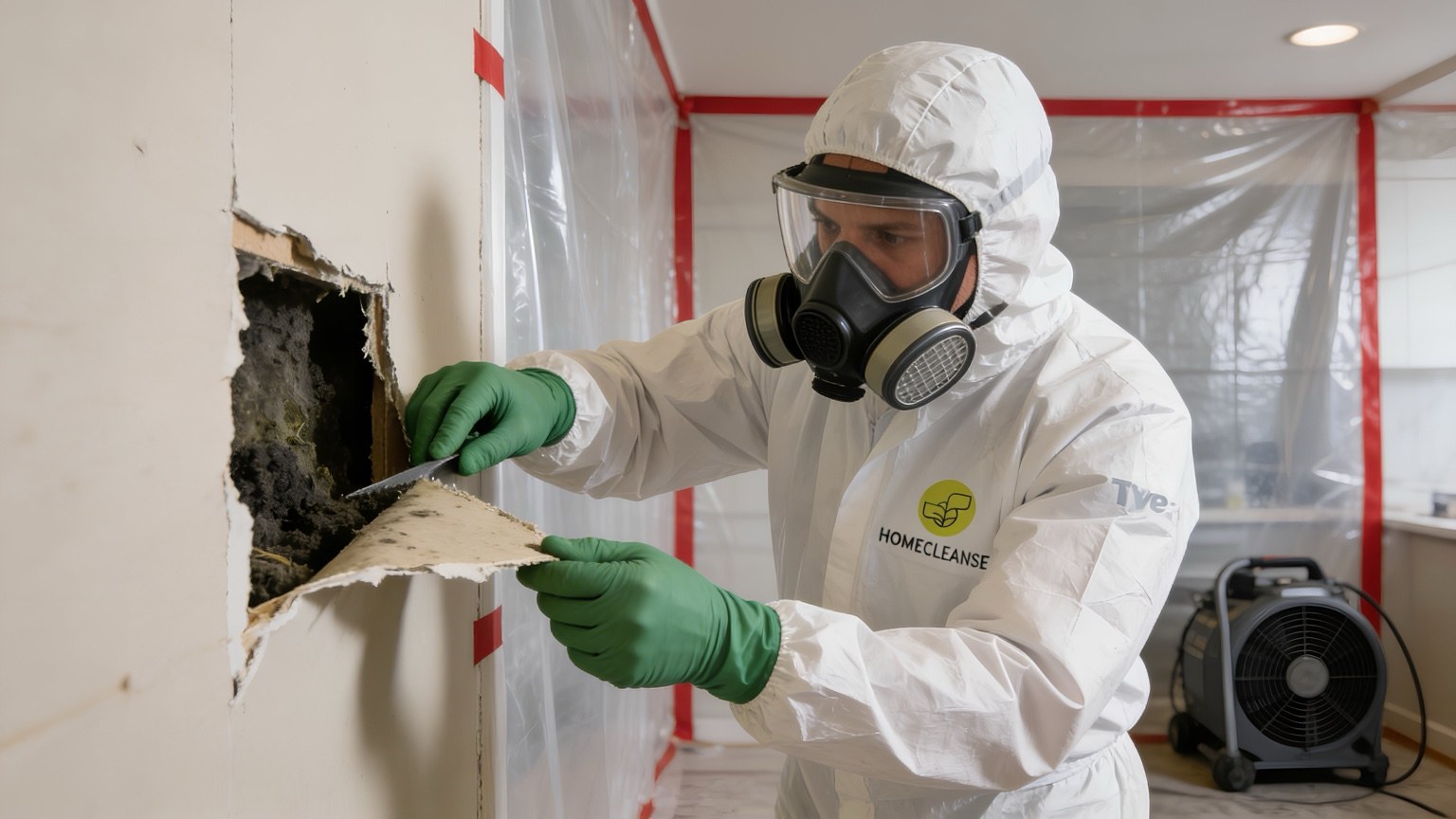
Mold remediation can be a messy process.
Depending on the extent of the problem, workers may need to remove drywall, insulation, flooring, cabinetry, or other contaminated materials. Structural materials may require detailed cleaning, and dust and debris can be generated throughout the process.
Without proper controls, particles disturbed during that work can move beyond the immediate remediation area and settle elsewhere in the home.
That’s why professional mold remediation isn’t simply about removing whatever has visible mold on it. The environment around the work also needs to be controlled.
Two important tools for doing that are containment and air filtration.
Containment separates the work area from unaffected portions of the building. Air scrubbers help filter particles suspended in the air inside that controlled area.
For larger mold remediation projects, it’s also recommended to maintain the containment area under negative pressure relative to surrounding spaces.
In plain English, negative pressure helps keep contaminated air inside the work area instead of allowing it to escape into the rest of the home.
Together, these controls can help reduce the spread of contamination while remediation is underway.
Can an Air Scrubber Remove Mold?
An air scrubber can capture airborne mold spores and fragments, but it cannot remove mold actively growing on building materials.
Imagine mold is growing on the back of a section of drywall after a plumbing leak.
When that drywall is disturbed or removed, an air scrubber can help capture particles that become airborne. But the machine cannot reach behind the wall, remove the contaminated drywall, clean the surrounding structure, or repair the plumbing leak.
Those parts of the problem still have to be addressed.
This is why simply putting an air scrubber in a room with mold is not mold remediation.
The Centers for Disease Control and Prevention (CDC) and National Institute for Occupational Safety and Health (NIOSH) emphasize the importance of addressing the moisture problem and properly cleaning up indoor mold growth.
Air Scrubber vs. Negative Air Machine: What’s the Difference?
The terms air scrubber and negative air machine are sometimes used interchangeably because similar HEPA-filtered equipment can be configured to perform either function.
The easiest way to understand the difference is to look at where the filtered air goes.
When a machine pulls air from a space, filters it, and releases that filtered air back into the controlled area, it is functioning as an air scrubber.
When compatible equipment is configured to exhaust filtered air from a sealed containment area, it can help create negative pressure inside the work zone.
Why does that matter?
Air naturally moves in response to differences in pressure. Maintaining lower pressure inside the containment encourages air to move into the controlled area rather than allowing potentially contaminated air to move out of it.
So the easiest way to remember the difference is:
Air scrubbing is primarily about filtering particles from the air. Negative air is primarily about controlling which direction air moves.
During professional remediation, the two work together.
Air Scrubber vs. Air Purifier: What’s the Difference?
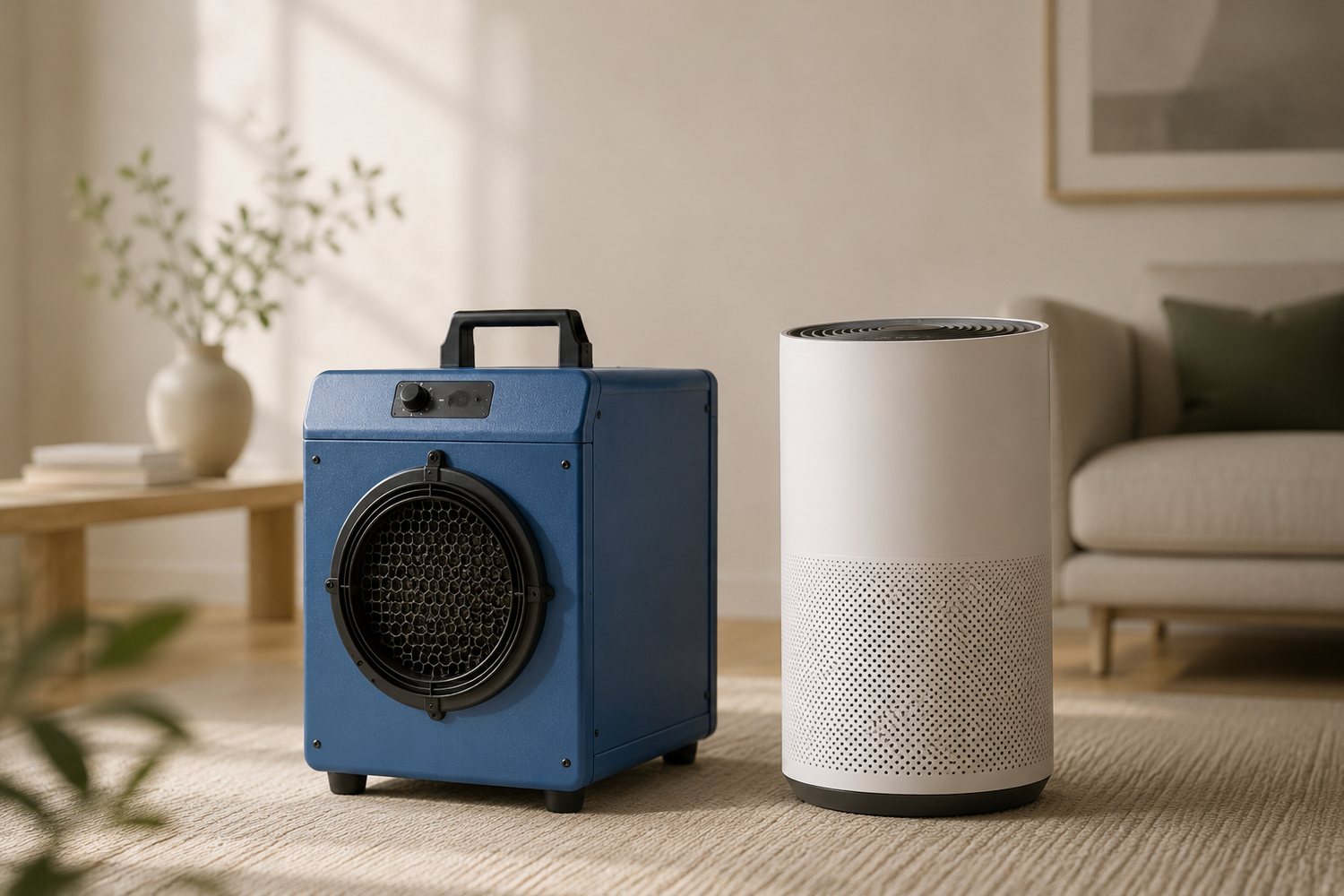
Air scrubbers and air purifiers both filter air, but they are generally designed for different situations.
Air Scrubber | Air Purifier | |
Typical purpose | Remediation, restoration, construction, and contamination control | Ongoing indoor air filtration |
Typical equipment | Portable professional or commercial unit | Consumer or commercial indoor unit |
HEPA filtration | Common in remediation equipment | Depends on the unit |
Airflow | Often designed for high-volume filtration | Varies by unit |
Negative-pressure applications | Compatible equipment may be configured for this purpose | Typically not designed for this purpose |
Can capture airborne mold particles | Yes, with appropriate particle filtration | Yes, with appropriate particle filtration |
Removes active mold growth | No | No |
Corrects moisture problems | No | No |
An air purifier can be useful for ongoing indoor air quality, while an air scrubber is typically used for more intensive projects that generate significant amounts of airborne particulate.
Neither one should be treated as a solution for active mold growth.
If mold is growing in a home, the source of the moisture and the contaminated materials still need to be addressed.

How Long Should You Run an Air Scrubber?
There is no universal number of hours an air scrubber should run during mold remediation.
The appropriate runtime depends on the actual conditions of the project, including:
The size and volume of the work area
The airflow capacity of the equipment
The type of work being performed
The amount of particulate being generated
Equipment placement and configuration
Filter condition
The remediation plan
That’s why blanket recommendations such as “run it for 24 hours” or “48 hours is always enough” can be misleading.
A small contained work area and a large remediation involving substantial demolition are very different environments.
What Do CFM and ACH Mean?
Two measurements commonly associated with air scrubbers are CFM and ACH.
CFM, or cubic feet per minute, tells you how much air a machine can move.
ACH, or air changes per hour, estimates how many times the volume of air within a space passes through the filtration system during one hour.
For example, imagine a contained area measuring:
20 feet long × 15 feet wide × 8 feet high
That gives you:
20 × 15 × 8 = 2,400 cubic feet
If a filtration device is effectively moving 500 cubic feet per minute:
500 CFM × 60 minutes ÷ 2,400 cubic feet = 12.5 theoretical air changes per hour
That calculation can help professionals understand the amount of filtration being provided, but it’s not the whole story.
Real-world performance can be affected by equipment placement, filter loading, airflow restrictions, ducting, leakage, the shape of the containment, and pressure differences.
In other words, the math is useful, but the actual conditions inside the work area still matter.
Can You Use an Air Scrubber at Home?
Yes. Portable air scrubbers can be used in residential environments, particularly during projects that generate a significant amount of dust or other airborne particles.
Common uses include:
Water damage restoration
Construction and renovation
Demolition
Other projects that create substantial airborne particulate
And again, what an air scrubber should not become is a permanent workaround for an unresolved problem.

What Air Scrubbers Don’t Do
Air scrubbers are powerful filtration tools, but understanding their limitations is just as important as understanding what they can do.
Air scrubbers don’t remove mold from building materials.
A HEPA air scrubber can capture mold-related particles that become airborne and enter the machine. It cannot remove an active colony growing on drywall, wood, insulation, flooring, or other materials.
Air scrubbers don’t fix moisture problems.
Mold needs moisture to grow. That moisture may come from a plumbing leak, roof leak, flooding, condensation, elevated humidity, poor ventilation, or another source.
Filtering the air does not correct any of those conditions.
Air scrubbers can’t prevent mold from returning if the underlying problem remains.
If the moisture source isn’t corrected, mold can grow again regardless of how much air filtration takes place.
This is why moisture control is such an important part of both mold remediation and mold prevention.
HEPA air scrubbers don’t necessarily remove VOCs.
HEPA filters are designed to capture particles. Volatile organic compounds, or VOCs, are gases.
Some machines include activated carbon or other filtration media designed to capture certain gases and odors. Their effectiveness depends on the contaminant, the type and amount of filter media, airflow, concentration, and other conditions.
So if VOCs are the concern, don’t assume a machine removes them simply because it is marketed as an “air scrubber.” The filtration inside the machine needs to be appropriate for the contaminant you’re trying to address.
The Bottom Line on Air Scrubbers
An air scrubber is a portable filtration machine used to capture airborne particles. During mold remediation, HEPA air scrubbers can help capture mold spores, fragments, dust, and other particulate disturbed by the work.
Depending on how the equipment is configured, HEPA-filtered machines can also be used as part of a negative-air system to help keep contaminated air from moving outside a remediation containment.
But an air scrubber does not remove mold growing on building materials, repair water damage, or correct the moisture conditions that allowed mold to grow.
That’s why air filtration works best as one part of a comprehensive remediation process that addresses the source, contaminated materials, airborne and settled particulate, and the underlying moisture problem.
If you’re dealing with mold in your home and aren’t sure what the next step should be, talk with a HomeCleanse Wellness Advisor to learn more about investigating the problem and determining the right path forward.
Have Questions?
A member of our team is here to help! Click on “Get Started ➤” below to book a consultation with a member of the HOMECLEANSE team. We have a few quick questions that will help us put together a roadmap to solve or prevent all of your mold problems.
Two minutes of your time could lead to better health for you and your family.
Frequently Asked Questions About Air Scrubbers
Do air scrubbers remove mold spores?
Yes. An air scrubber equipped with HEPA filtration can capture airborne mold spores and other mold-related particles that enter the filtration system. It does not remove mold actively growing on building materials.
Does an air scrubber kill mold?
No. An air scrubber should not be considered a method for killing or removing active mold growth. Its primary role during remediation is filtering airborne particulate.
Is an air scrubber the same as a HEPA filter?
No. A HEPA filter is a type of high-efficiency filter designed to capture airborne particles. An air scrubber is a machine that moves air through a filtration system. Professional air scrubbers used during mold remediation commonly contain HEPA filters.
Can you stay in a house while an air scrubber is running?
Whether a home can be occupied during mold remediation depends on the extent and location of contamination, the work being performed, the containment strategy, the remediation plan, and the people living in the home.
The CDC advises that people with asthma or COPD and people who are immunocompromised should not stay in a moldy home or be present while mold is being cleaned. Occupancy decisions should therefore be based on the conditions of the individual project rather than the presence of an air scrubber alone.
Do air scrubbers remove odors?
It depends on the machine and the source of the odor. HEPA filters are designed to capture particles, not gases. Some air scrubbers include activated carbon or other media that may help capture certain gaseous contaminants and odors, but performance varies based on the filtration system and contaminant involved.
Can an air scrubber prevent mold?
No. Air filtration can reduce airborne particles, but preventing mold growth primarily requires controlling moisture. Leaks, water damage, condensation, elevated humidity, and other moisture problems need to be corrected to reduce the conditions that allow indoor mold growth.
Must-Have Indoor Air Quality Tools
-

EC3 Laundry Additive
Add EC3 to every rinse cycle to rinse away mold, bacteria and musty odors from...
-
$23.00 Shop Now -

HomeCleanse Shield
Turn your HVAC into the healthiest feature of your home.
-
$2,495.00 Shop Now -
HomeCleanse Cleaning
Take your cleaning to the next level buying all the tools we use to keep...
-
Price range: $299.00 through $549.00 Shop Now -
Mold & Bacteria Contents Cleaning
Remove harmful pollutants that accumulate in the dust of your home. (Options available for renters...
-
Price range: $99.00 through $349.00 Shop Now -

EC3 Mold Solution Concentrate
Micro Balance EC3 Mold Solution Concentrate is a natural botanical that removes mold spores, bacteria,...
-
$33.00 Shop Now -

The Dust Test
Optimizing Air Quality starts with finding what’s not optimal. *Detects 36 different species of mold...
-
$299.00 Shop Now -
EuroClean 4 Gallon Hepa Vacuum
The Euroclean GD930HSP is a 4 Gallon Dry HEPA Vacuum that meets the EPA's standards...
-
$849.00 Shop Now