When Symptoms
Don't Have Clear Answers
If you've been searching for answers, you're not alone.
Let's start by understanding what
you're experiencing.
Let's Start With What You're Experiencing
This part of the journey isn't a diagnosis.
We're making zero
assumptions.
Symptom patterns are simply worth exploring because symptoms are rarely random.
They're signals.
Persistent symptoms can be difficult to navigate.
Especially when they feel inconsistent, hard to explain, or resistant to clear answers.
For many people, the search becomes focused inward:
- Testing
- Appointments.
- New approaches.
- Repeat.
Yet symptoms do not exist in isolation within the body.
They unfold within the environments we move through every
day.
Before exploring possibilities, let's begin somewhere simple.
Your observations.
This only takes about 2 minutes.
The Brief Assessment
This brief assessment isn't designed to diagnose or label.
It simply helps
identify wellness patterns that are frequently worth exploring further.
There are no right or
wrong answers.
Only your experiences.
Q1 — Have you been experiencing any ongoing symptoms over the past few months?
Examples: fatigue, brain fog, headaches, sinus issues, sleep disruption, skin irritation, digestive
changes
Q2 — Are these symptoms affecting more than one area of your health?
Examples:
- Cognitive (focus, memory)
- Energy (fatigue, crashes)
- Respiratory (sinus, breathing)
- Neurological (headaches, dizziness)
- Inflammatory (skin, joints, digestion)
Q3 — Do these symptoms happen at least weekly?
Q4 — Have these patterns been present for 3 months or longer?
Q5 — Do you feel noticeably better when you're away from home?
Example: travel, staying elsewhere, extended time outside your home
Q6 — Does anyone else in your household or building experience similar symptoms?
Symptoms are rarely linear.
- They shift.
- They fluctuate.
- They evolve.
This process is about recognition, not conclusions.
Q7 — Have these symptoms remained unresolved despite your efforts to improve them?
Examples: improving sleep, reducing stress, changing routines, trying treatments, seeking care
Q8 — Have these patterns affected your day-to-day functioning?
Examples: sleep, focus, work, mood, exercise, relationships
Q9 — Have you noticed moisture issues or environmental clues in your home?
Examples:
- Leaks or past water damage
- Humidity or damp areas
- Musty or earthy odors
- Recurring condensation
- Rooms that feel heavy or stagnant

Enter your details to continue:
Nothing Strongly
Suggestive For Now
Here's how your responses generally align:
Based on your responses, there aren't strong indicators pointing toward a clear environmental pattern at this time.
That doesn't dismiss what you've been feeling.
Symptoms can shift gradually. They can rise and fall with stress, routine, sleep, or subtle changes in surroundings. Sometimes patterns take time to reveal themselves.
Awareness isn't about urgency. It's about perspective.
Even when signals feel mild, understanding how indoor environments function can add helpful context.
And context often brings peace of mind.
Now, we'll look at what these patterns may suggest.
Something Subtle
May Be Taking Shape
Here's how your responses generally align:
Your responses suggest early signals that may be worth gently exploring.
Nothing here points to a definitive answer.
But when symptoms linger, fluctuate, or resist easy explanations, it can be reassuring to widen the lens.
Environmental influences are rarely dramatic. They tend to be gradual. Layered. Easy to overlook.
Sometimes clarity begins not with certainty, but with curiosity.
Looking more closely at how your indoor space functions may offer a perspective that hasn’t yet been considered, and that alone can be empowering.
Now, we’ll look at what these patterns may suggest.
Several Meaningful
Patterns Are Present
Here's how your responses generally align:
Your responses reflect a pattern of persistent symptoms alongside environmental variability that deserves thoughtful attention.
When symptoms shift by location, affect daily life, or remain unresolved despite effort, it’s natural to start asking deeper questions.
This is not a final conclusion.
It’s a signal that your experience has structure, and structure can be explored.
When patterns align across timing, surroundings, and symptom load, examining indoor environmental conditions becomes a constructive and grounded next step.
Clarity doesn’t come from assumptions.
It comes from informed exploration.
Now, we’ll look at what these patterns may suggest.
A Clear
Pattern Is Emerging
Here's how your responses generally align:
Your responses indicate persistent symptoms alongside meaningful environmental signals.
When symptoms improve away from home, affect multiple people in the same space, or continue despite medical evaluation, it can feel frustrating, even isolating.
This does not define a diagnosis.
It does not imply causation.
It highlights alignment between what you’re experiencing and the context in which you’re experiencing it.
In situations like this, turning attention toward the indoor environment can provide direction when other paths haven’t offered clarity.
Understanding how modern homes behave may be a valuable step toward finding answers that feel grounded and actionable.
Now, we’ll look at what these patterns may suggest.
Symptom Patterns
Raise Interesting Questions
No conclusions.
No diagnoses.
Just perspectives worth considering.
Symptoms are often evaluated through a biological lens.
Which is understandable!
But symptoms also unfold within environments.
The spaces we occupy daily. Spaces that are often overlooked when determining what the body is trying to signal that something is amiss through chronic symptoms.
For some individuals, certain
patterns
invite a broader question:
Could
something in the surrounding
environment be influencing how the body
feels?
This question is rarely obvious.
Not because it lacks importance.
But because environmental factors are
often subtle,
gradual, and difficult to recognize without context.
We also simply haven't been taught to
consider the
spaces around us and how they influence health.
Exploring how modern homes behave often
provides a meaningful starting point
for connecting
these broader patterns.
A guided exploration of the modern indoor environment.
Your Home is More Than
a Backdrop
When symptoms feel persistent, inconsistent, or difficult to fully
explain,
attention naturally turns inward.
- The body becomes the primary focus.
- Yet every physiological process unfolds within context.
- Within surroundings.
- Within environments that remain quietly present
throughout daily life. - Among these, one variable is nearly constant:
- The home.
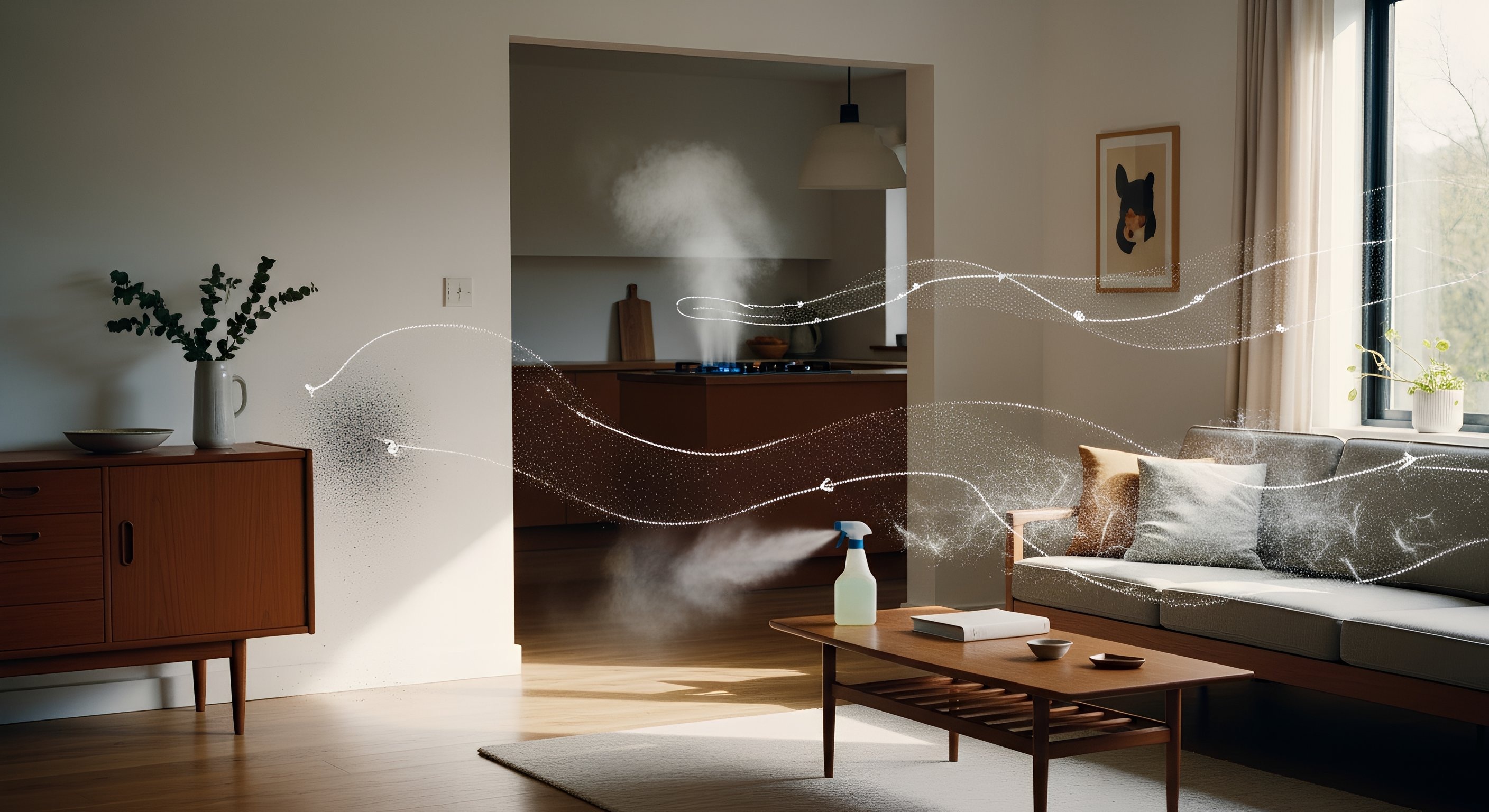
Beneath Stillness, Constant Movement
Modern homes are engineered for stability, comfort, and efficiency.
But stability does not mean stillness.
- Air circulates.
- Moisture shifts.
- Particles move.
- Materials respond.
These processes unfold continuously, largely invisible to the naked eye.
Yet constantly shaping the indoor environment.
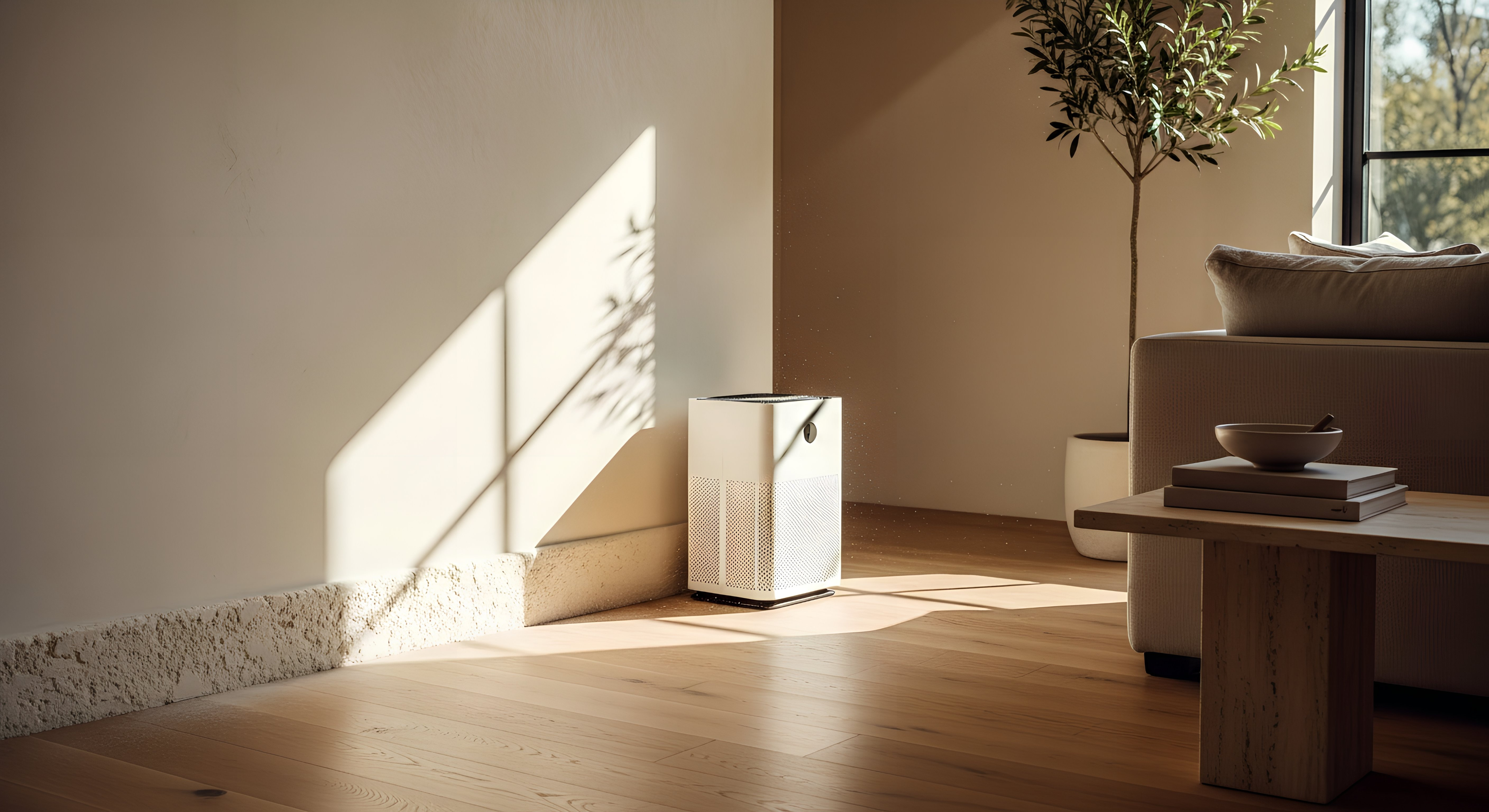
Invisible Environmental Variables
Airborne Particles
Microscopic materials that naturally exist
indoors
and
shift with movement, airflow, and conditions.

Moisture Dynamics
Subtle fluctuations in humidity and dampness
influence how indoor environments behave over time.
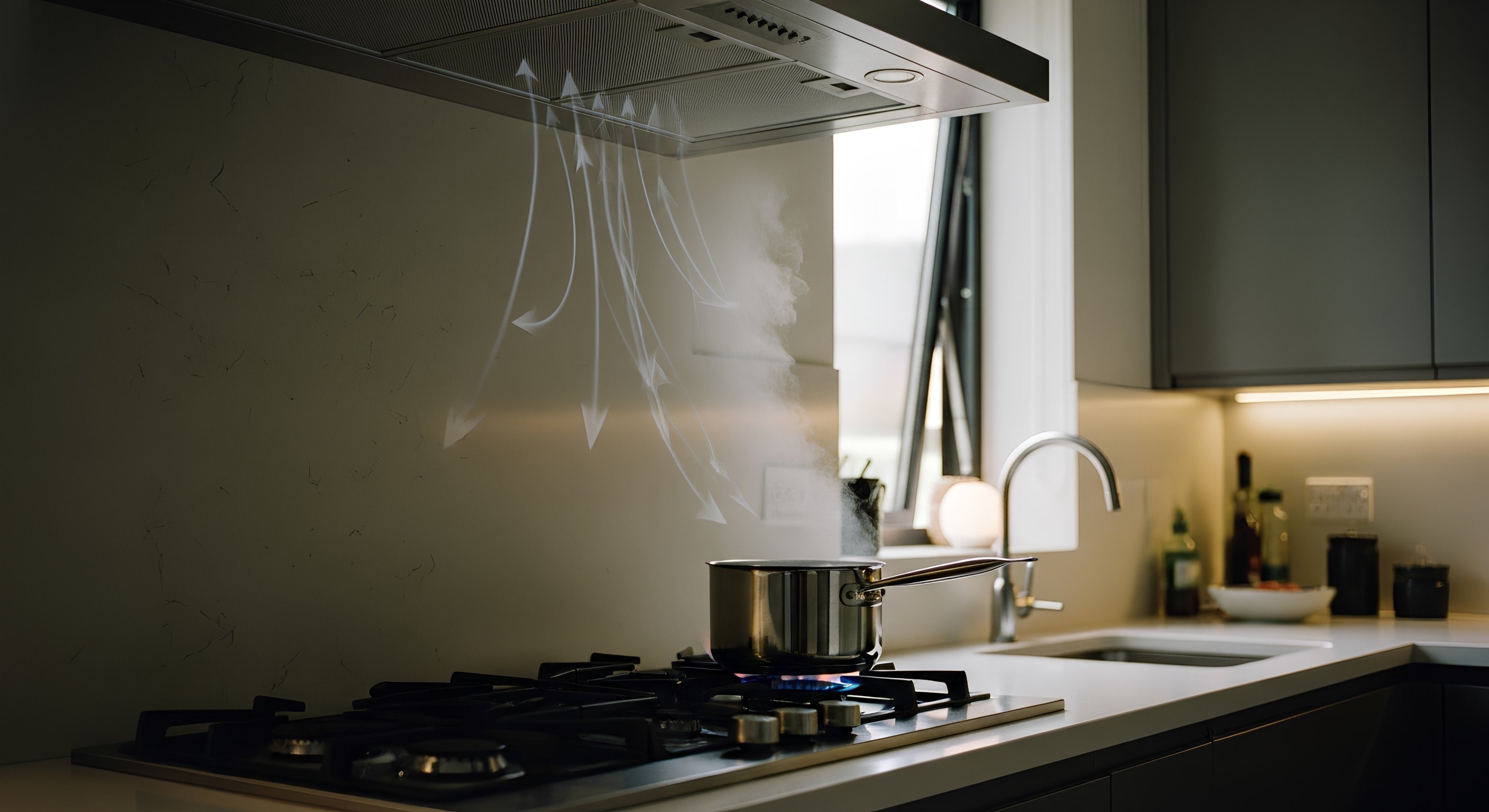
Material Interactions
Every surface continuously responds to the
surrounding air, temperature, and environmental
variables.

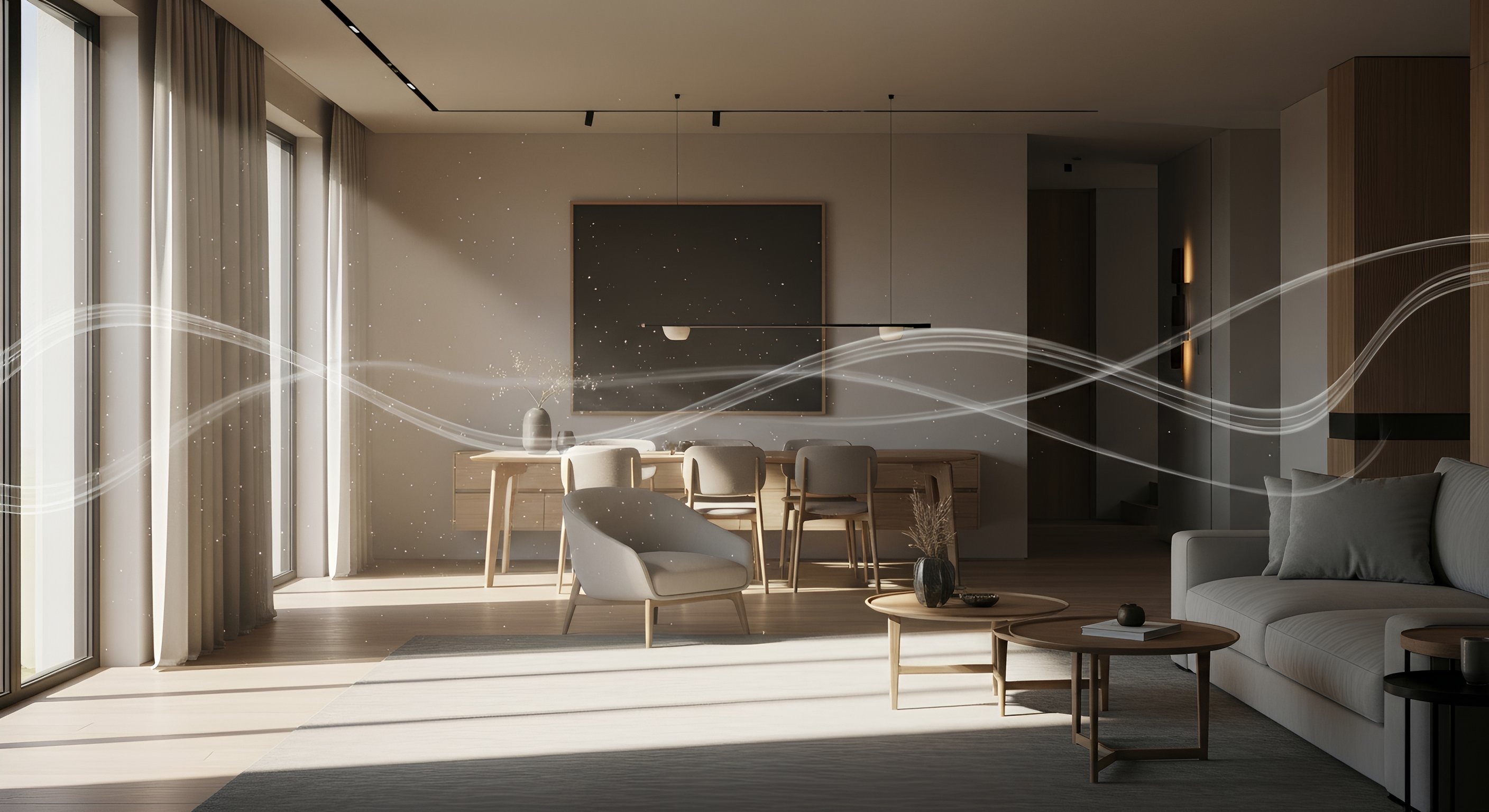
Airflow Patterns
How air moves through a home influences
where
particles travel, settle, and accumulate.
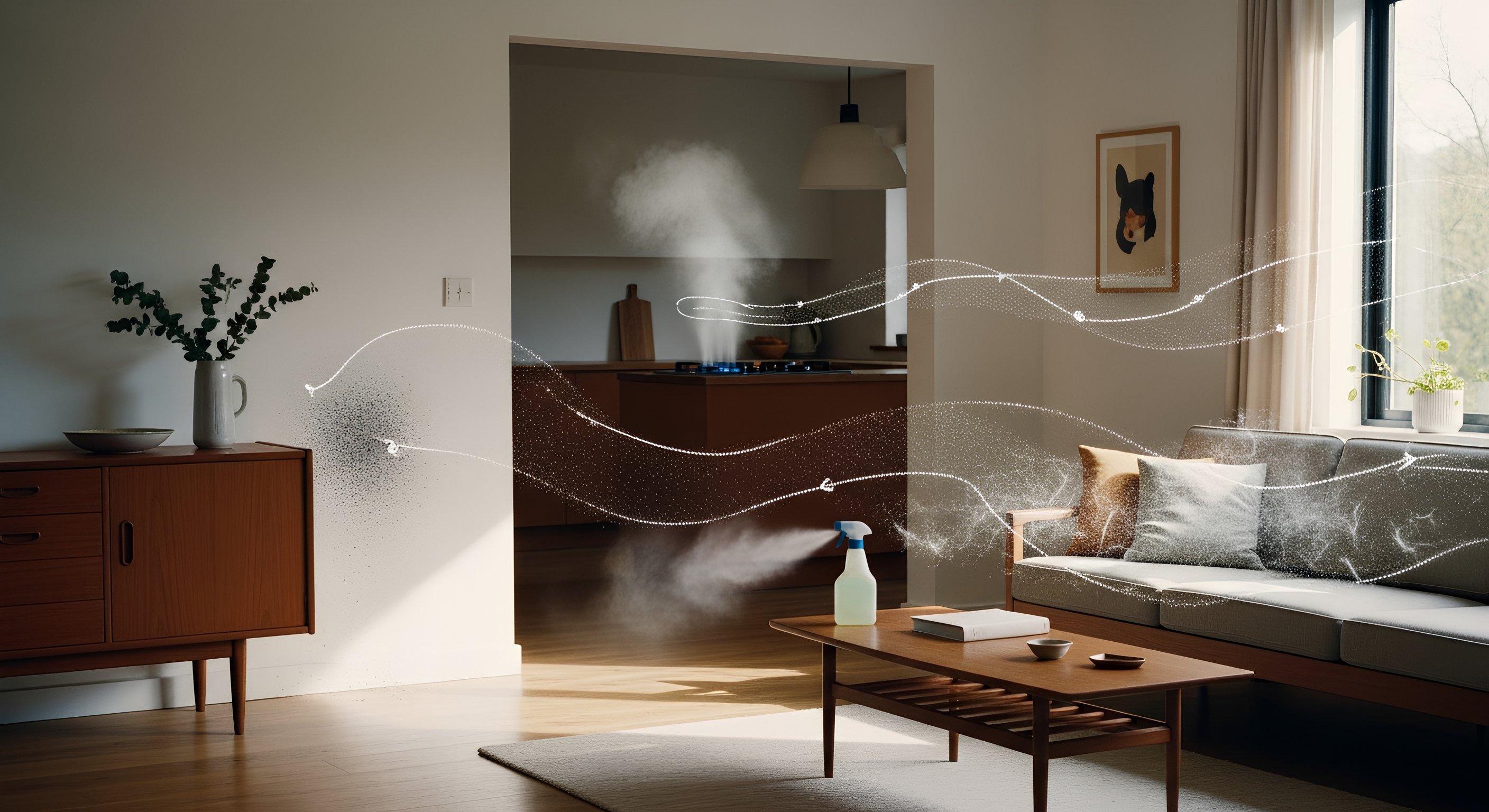
Indoor Gases
Invisible components that contribute to the
overall
composition of indoor air.
Environmental Accumulation
Small variables that may gradually build
depending on conditions and maintenance
patterns.

For Those Who
Want to Go Deeper

Indoor environments are shaped by layers of interacting variables that are rarely visible and often misunderstood. We made a visual guide that helps turn complex indoor variables into something that is actually easy to understand. A visual guide to understanding indoor environments & health.
Please enter your details to download
the Picture Book
A visual guide to understanding indoor environments & health.
The Modern Home Is a Dynamic System
Modern indoor environments are influenced by far more than
cleanliness or visible damage.
They reflect a combination of design choices, materials, airflow,
moisture
behavior, and everyday living patterns.
Many of the variables shaping indoor spaces operate quietly,
remaining largely unnoticed without deliberate attention.
Indoor environments are not shaped by a single factor.
They reflect layers of interacting influences, many of which are built directly
into how
homes function today.
Building & Design Dynamics
Modern homes are engineered for performance, yet complexity often
introduces variables that are not immediately apparent.
Ventilation & Air Exchange
How a home breathes influences how indoor conditions stabilize,
shift, and evolve.
Moisture Behavior
Subtle moisture variations can influence environmental balance in
ways that are rarely visible.
Hidden Structural Pathways
Air and particles move through areas of the home that typically
remain unnoticed.
Material & Environmental Load
Every material contributes, however subtly, to the overall indoor
environment.
Awareness & Maintenance Patterns
Environmental management is rarely part of traditional
homeowner education.
Your Body Constantly
Interacts With This
Environment
Breathing isn’t occasional.
It’s continuous.
Which means indoor air quality isn’t a background detail.
It’s part of your body’s everyday experience.
In fact, most people spend 90% of their
day inside.
Indoor air, conditions, and
surroundings quietly
accompany nearly every physiological process.
Often unnoticed.
Yet constantly present.

This Doesn’t Mean
Something Is Automatically
“Wrong” With Your
Home
Every indoor environment contains variables.
- Particles.
- Gases.
- Biological materials.
Presence alone is not the defining factor.
What matters is balance,
accumulation, and the
conditions shaping how environments behave
over
time.
Exploration is not about alarm.
It is about understanding.
Understanding the Environment Is Only the Beginning
You Breathe Roughly 20,000
Times Each Day
Breathing is not something you do occasionally
It is something your body does constantly
On average, you take close to 20,000 breaths every day
Most of those breaths happen indoors
Air is the primary way your environment interacts with your body
Not once
But thousands of times, day after day.
Every inhale carries whatever is suspended in that space.
Microscopic
particles. Biological fragments. Gases.
At low levels, most are neutral.
When exposure becomes continuous or elevated, the body may
respond
differently over time.
Because breathing never stops, exposure is rarely isolated.
Your Body Is Always
Responding
The immune system is designed to detect change.
- It filters.
- It evaluates.
- It adjusts.
When exposures are minimal or temporary,
the
body adapts quietly.
When exposures are repetitive, concentrated,
or
prolonged, responses can become more noticeable.
- Not dramatic.
- Not immediate.
- Gradual.
- Subtle inflammation.
- Fluctuating symptoms.
- Patterns that feel inconsistent or difficult to trace.
Every individual responds differently.
Genetics, stress load, prior health history,
and
duration of exposure all influence how the body
reacts.
What affects one person may not affect another.
The important distinction is this:
The body does
not separate itself from its
surroundings.
It is in continuous dialogue with them.

Sometimes the Missing
Variable Is Not Inside the
Body
When symptoms persist despite effort, it is
natural
to look for new explanations.
- Another test.
- Another approach.
- Another specialist.
But when patterns fluctuate by location,
improve
when away from home, or resist conventional
answers, context becomes
relevant.
Not as a replacement for medical care.
As an additional lens.
Understanding
how exposure works and how the
body responds to repeated environmental
input
provides a clearer foundation for what comes next.
Allow this section breathing room before transition
How Can You Tell
If Your Home May Be
Contributing?
Environmental influence rarely announces
itself loudly.
There is no single moment of realization.
Instead, there are
small indicators.
Clues.
Patterns that become clearer when viewed together.
If you are wondering how to evaluate your
own
environment in a calm, structured way, without panic or
guesswork, the
next step in our journey offers exactly
that.
This is not about fear. It’s about clarity.

Here’s How Most People
Continue
You do not need to decide everything at once.
Start where you feel comfortable.
- You can observe.
- You can learn.
- You can gather data.
- Or you can speak with someone directly.
Each path is designed to bring you peace of mind.
Start With Understanding
Your responses suggest that building awareness
may
provide the most clarity at this stage.
There are no strong indicators suggesting that
structured testing or intervention is immediately
necessary. However, that’s
where learning comes
into play.
Understanding how modern homes behave, how exposure works, and how environmental patterns develop can provide meaningful context moving forward.
Move From
Awareness to Structure
Your responses reflect meaningful patterns
that may benefit from a more structured
evaluation approach.
Before jumping directly into environmental
testing, a clear, step-by-step assessment
framework can help determine what is
truly necessary and what is not.
You can always choose a different path below.
Prefer to begin with foundational education?
Explore the Structured Assessment System
Gather Objective
Environmental Data
Your responses indicate persistent symptom
patterns alongside environmental variability.
When signals align at this level, structured
environmental testing often provides the clearest
direction forward.
Objective data helps determine whether further
inspection or intervention is warranted.
You can always choose a different path below.
Schedule a Consultation.
If you would like to review every pathway
in detail, you can explore
them below.
Begin With Simple
Observation
Take the Free
2-Hour Course
Go Deeper With a Practical
Assessment
System
Use Environmental
Testing for
Clarity
Schedule a Consultation
Begin With Simple Observation
You do not need specialized tools to begin.
Start with calm, structured awareness.
A surprisingly helpful place to look is inside your toilet tank.
Lift the lid and examine the interior walls.
- Do you notice discoloration?
- Dark spotting?
- Unexpected buildup along the water line?
Toilet tanks have very limited air movement. While the tank isn’t airtight, it doesn’t get the same airflow as the rest of the bathroom.
That means: If you see mold inside the tank, it’s usually not just a random coincidence.
A single stray spore could end up there. But more often, it points to higher levels of mold spores circulating in the home, settling in damp spaces where conditions allow growth.
This is not a complete sure sign.
But it is a helpful clue.
Other subtle indicators may include:
- Condensation that lingers on windows
- Rooms that consistently feel heavier or more humid
- Musty or earthy odors that come and go
- Symptoms that soften when traveling
- Minor water events that were never fully evaluated
Individually, these seem like small issues.
Together, they create context.
Take the Free 2-Hour Course
If you would prefer a structured walkthrough, the free course explores:
- Why certain symptoms resist conventional explanation
- How modern homes behave as dynamic systems
- The air-body interface and cumulative exposure
- Moisture behavior and accumulation patterns
- Why visible growth is often only part of the story
- How to evaluate your home calmly and logically
This course is designed to create clarity and put the power back in your hands.
Go Deeper With a Practical Assessment System
For individuals who want a step-by-step framework, the Structured Home Environmental Assessment course includes:
- Moisture logging worksheets
- Airflow mapping exercises
- Testing comparison charts
- Contractor vetting checklists
- Remediation scope review tools
- Long-term maintenance planning templates
This is not just education.
It is a toolkit that gives you confidence in your decisions.
Use Environmental Testing for Clarity
Observation builds awareness.
Data builds confirmation.
The Dust Test analyzes settled indoor particles to identify possible mold sources that are not visible to the eye.
It does not diagnose illness.
It provides structured environmental insight that can guide your next step.
If testing reveals elevated accumulation, a structured environmental inspection is typically the next step
Schedule a Consultation
If you would rather review your situation with professional guidance, consultations are always available
This allows you to discuss symptom patterns, home history, and evaluation findings in a structured conversation.
Sometimes clarity comes through dialogue.